
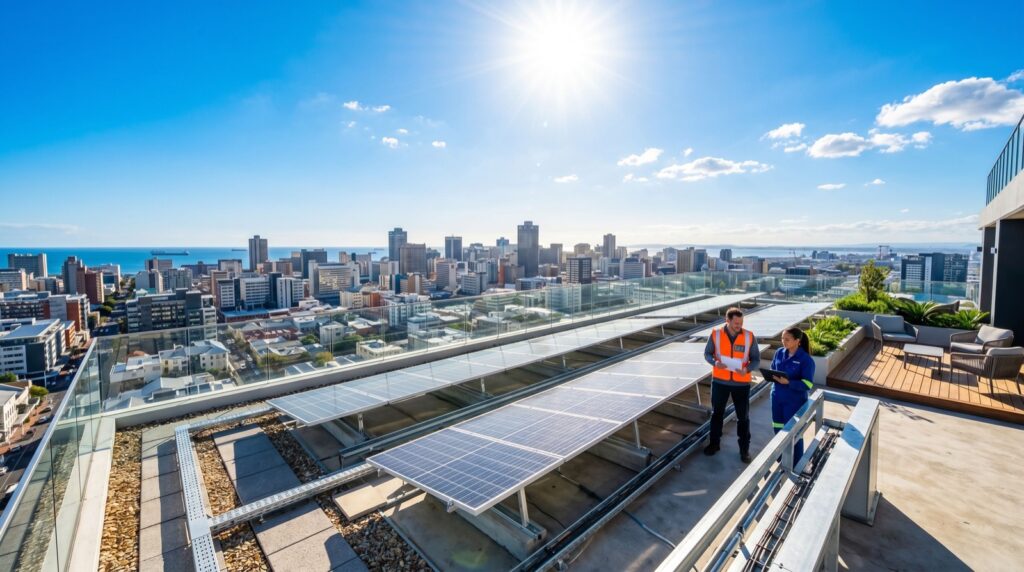
Installing quality solar panels in Karachi comes with a challenge most inland cities never face: salt-laden coastal air. The sea breeze that keeps the city cooler also accelerates corrosion on cheap hardware, which is why coastal solar demands smarter material choices. In this 2026 guide, we explain how humidity, salt, and sea air affect rooftop systems, and how to build one that thrives for decades by the coast.
Solar works brilliantly in Karachi thanks to abundant sunshine and long clear seasons. The trick is protecting your investment from the marine environment so those years of strong sun translate into decades of reliable output.
Why coastal air matters for solar panels in Karachi
Salt in the air settles on every exposed surface. On budget mounting frames, connectors, and junction boxes, that salt speeds up corrosion dramatically. A system that would last 25 years inland can degrade far faster near the coast if the wrong materials are used.
The good news is that this is entirely preventable. Marine-grade aluminum, sealed connectors, and corrosion-resistant coatings are proven solutions. They cost slightly more but pay for themselves by preventing early failures and costly rework.
Guidance from the U.S. Department of Energy emphasizes that mounting and electrical components must match local environmental conditions, and coastal humidity is exactly the kind of condition that demands upgraded hardware.
The corrosion chain reaction
Corrosion rarely announces itself. It starts quietly at a connector or a bolt, then spreads. By the time output drops noticeably, the damage may already require replacing parts. Choosing the right materials up front stops that chain before it begins.
Coastal versus inland: what changes
Comparing Karachi to an inland industrial city like Sialkot shows how much environment shapes the ideal system. The table below highlights the key differences installers must account for in 2026.
| Factor | Karachi (Coastal) | Sialkot (Inland) |
|---|---|---|
| Main threat | Salt air, humidity | Dust, temperature swings |
| Mounting needs | Marine-grade aluminum | Standard corrosion-resistant |
| Connector sealing | Critical priority | Standard sealing fine |
| Sun availability | Very high, long clear season | High with monsoon dip |
Neither location is harder to serve; each simply needs a system designed around its dominant condition. That is why local experience beats generic packages.
Building a corrosion-resistant coastal system
A durable Karachi installation rests on a few deliberate hardware choices. Skimping on any of them undermines the whole array over time.
- Marine-grade aluminum rails and stainless fasteners.
- Fully sealed, weatherproof cable connectors.
- Junction boxes rated for high humidity.
- Anti-corrosion coatings on exposed metal.
- Elevated mounting to improve airflow and drainage.
These upgrades add modestly to cost while dramatically extending system life. On the coast, they are not optional extras; they are the foundation of a system that lasts.
How Sialkot systems differ
Inland, the priority shifts to dust management and handling wider temperature swings. Buyers of solar panels in Sialkot benefit most from steep tilt angles that shed dust and from panels with a strong temperature coefficient. The corrosion concern eases, but thermal design becomes more important.
Choosing an installer for coastal conditions
Not every installer understands marine environments. The best ones have a portfolio of coastal projects and can explain, without prompting, exactly which materials they use to fight salt corrosion. That specificity is the mark of genuine expertise.
Work with trusted professionals who provide corrosion-resistant hardware in writing, back it with clear warranties, and offer scheduled maintenance suited to coastal wear. A cheaper quote that ignores salt protection is no bargain at all.
Before you commit, confirm the following:
- Are the mounting rails marine-grade aluminum?
- Are all connectors sealed against humidity?
- What warranty covers corrosion-related failures?
- How often should coastal panels be inspected?
- Do you handle the full net-metering process?
Maintenance by the sea
Coastal systems benefit from slightly more frequent inspection than inland ones. A periodic check of connectors and mounting hardware catches early salt damage before it spreads. Rinsing panels also removes salt film that can dull output over time.
Fortunately, this maintenance is quick and inexpensive when built into an annual plan. The reward is a system that keeps generating strong power year after year, fully repaying the extra care coastal living requires.
The financial case for coastal solar
Beyond durability, the economics of solar in Karachi are compelling in 2026. Grid tariffs continue climbing, while equipment prices have fallen, and the city’s generous sunshine means panels spend more hours near peak output than in cloudier regions. That combination shortens the payback period considerably.
Net metering seals the deal. Surplus daytime power flows to the grid and earns credits you draw back at night, effectively erasing most of your bill. Even after budgeting for corrosion-resistant hardware, most coastal households recover their investment within roughly four to six years.
After that payback point, the electricity is essentially free for the remaining two decades of panel life. Few investments available to an ordinary family offer that kind of predictable, inflation-proof return. The extra spend on marine-grade materials simply protects that return over the long haul.
Ways to maximize your coastal return
- Size the system to your daytime consumption for best net-metering value.
- Choose durable hardware to avoid corrosion-driven repair costs.
- Keep panels rinsed so salt film never dulls output.
- Monitor generation monthly to catch faults early.
- Schedule an annual inspection to protect long-term yield.
Common myths about coastal solar
Some Karachi homeowners still believe the sea air makes solar impractical. That myth persists because early, poorly built systems did corrode. Modern marine-grade installations tell a very different story, lasting just as long as inland arrays.
Another myth is that humidity ruins output. In reality, humidity has little direct effect on generation; the concern is corrosion of hardware, which proper materials fully address. Once you separate fact from folklore, coastal solar reveals itself as an excellent, well-proven investment in 2026.
Frequently Asked Questions
Does salt air really damage solar systems?
Yes, salt accelerates corrosion on metal components and connectors. Using marine-grade materials and sealed hardware prevents this, allowing coastal systems to last as long as inland ones with proper design.
Is Karachi a good place for solar?
Absolutely. Karachi enjoys abundant sunshine and long clear seasons, making it excellent for solar. The only special requirement is corrosion-resistant hardware to handle the coastal environment.
How often should coastal panels be inspected?
A professional inspection once or twice a year is ideal near the coast. This catches early salt-related wear on connectors and mounting hardware before it affects performance or safety.
Do I pay much more for coastal-grade hardware?
The premium is modest compared to the system’s total cost, and it prevents expensive early failures. Over the system’s life, the upgraded materials save money by avoiding corrosion-driven repairs.
Conclusion
Coastal solar panels in Karachi can deliver decades of dependable output, provided the system is built to resist salt and humidity. By insisting on marine-grade mounting, sealed connectors, and an installer who knows the coast, you turn Karachi’s abundant sunshine into lasting savings. Match the hardware to the environment, maintain it lightly, and your rooftop will keep paying you back well into the 2040s. Ready to go solar the right way? Request a coastal-grade system quote today.