
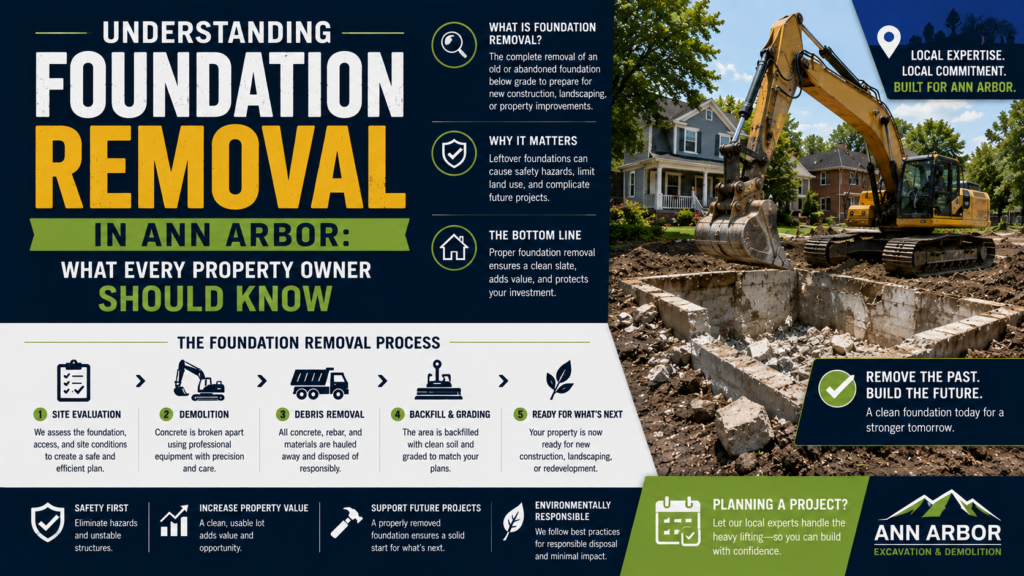
When a building reaches the end of its serviceable life, when a property needs to be repurposed, or when structural damage makes renovation unfeasible, Foundation Removal Ann Arbor becomes necessary. This is one of the most technically demanding phases of any demolition or redevelopment project. In Ann Arbor, Michigan, where soil composition, seasonal freeze-thaw cycles, and a mix of historic and modern construction all come into play, understanding this process is valuable for any property owner or developer planning a ground-up project.
What Is Foundation Removal?
Foundation removal refers to the complete or partial deconstruction and extraction of a building’s load-bearing concrete or reinforced concrete substructures from the ground. This includes strip foundations, isolated pad foundations, full basement walls, concrete slabs, and ground beams. The goal is to safely separate the foundation from the subsoil, break it into manageable pieces, and clear the site in preparation for whatever comes next, whether that is new construction, landscaping, or land restoration.
It is a distinct service from foundation repair, which addresses cracks, bowing walls, or settling. Removal is a more comprehensive undertaking, typically required when an entire structure is being demolished or when the existing foundation is too compromised to salvage.
Why Ann Arbor Properties Present Unique Challenges
Ann Arbor sits in Washtenaw County and experiences a full range of Michigan seasons. The local soil is characteristically clay-heavy in many areas, which expands when saturated with moisture and contracts during dry periods. This cyclical movement is one of the primary reasons older foundations in the region develop cracks, shift, or begin to deteriorate over time.
The freeze-thaw cycle is another key factor. During winter months, water in the soil freezes and expands, exerting upward and lateral pressure on concrete structures, a phenomenon known as frost heave. Over successive winters, this stress compounds and can cause significant structural damage to foundations. Proximity to the Huron River and Ann Arbor’s generally high groundwater table in certain neighborhoods also means moisture management is a constant consideration during removal projects.
How the Foundation Removal Process Works
Professional foundation removal is not simply a matter of driving heavy machinery onto a site and breaking concrete. It follows a structured sequence:
1. Site Assessment and Planning
Before any work begins, contractors conduct a thorough site inspection. This involves reviewing architectural drawings or engineering documents if available, identifying utility lines, assessing the foundation type and depth, and evaluating surrounding structures or hazards. In Ann Arbor’s older residential neighborhoods, buildings are often close together, and vibration control is essential to avoid affecting neighboring properties.
2. Hazardous Material Survey and Utility Disconnection
Older structures in Ann Arbor, particularly those built before the 1980s, may contain asbestos in pipe insulation, floor tiles, or exterior materials. A certified hazardous materials survey is conducted before demolition begins. All utilities, including gas, water, sewer, and electricity, must be formally disconnected and capped to prevent dangerous conditions during the removal process.
3. Structural Demolition
Once the above-ground structure is removed, the foundation itself is exposed and addressed. Depending on its depth, construction type, and the reinforcement density within it, contractors select from several methods. Hydraulic excavators with breaker attachments are commonly used for thick concrete walls. Concrete pulverizers crush material efficiently, while hydraulic splitting tools allow for more controlled, low-vibration separation in sensitive areas. Reinforcing steel is separated from concrete during this phase for recycling.
4. Debris Removal and Recycling
Concrete, rebar, and other demolition materials are hauled from the site. Responsible contractors sort these materials for recycling. Concrete can be crushed and repurposed as aggregate for road base or new construction fill. Ann Arbor has a strong environmental ethic, and many demolition projects here divert significant volumes of material from landfills through organized recycling programs.
5. Backfill, Grading, and Site Preparation
After the foundation is extracted, the void left behind must be properly backfilled with compacted soil to prevent future settlement. The site is then graded to achieve the correct drainage slope, preventing water from pooling. This final stage is critical and is often overlooked, yet it directly affects whether a future structure will sit on stable ground.
Common Reasons Foundation Removal Is Needed
Several scenarios lead property owners toward foundation removal rather than repair. These include:
- Complete structural failure where the foundation has shifted, cracked, or deteriorated beyond the point where repairs would be cost-effective or structurally sound.
- Planned redevelopment where the existing building footprint must be completely cleared to make way for a new structure with different dimensions or a modern foundation system.
- Land use conversion, such as turning a former commercial or residential site into green space, a parking area, or a different type of construction.
- Old basement foundations that are no longer needed or that contain hazardous materials like crumbling concrete with high moisture infiltration.
Permits and Regulations in Ann Arbor
Foundation removal in Ann Arbor requires permits from the City of Ann Arbor Building and Planning Department. The scope of required documentation depends on the scale of the project and whether a new structure will follow. Projects involving hazardous material removal require separate documentation and must be handled by certified abatement professionals. Contractors working in Ann Arbor must also be familiar with local ordinances related to noise levels, working hours, and waste disposal, all of which are regulated to protect neighboring properties and the broader environment.
The Role of Soil Conditions in Post-Removal Preparation
One of the most important aspects of foundation removal that is frequently underestimated is what happens to the soil afterward. When a foundation is removed, the void space and disrupted earth must be carefully restored. In Ann Arbor’s clay-heavy soils, improper compaction can lead to differential settlement, where parts of a new structure sink at different rates. Proper compaction testing before any new foundation work begins is not just best practice, it is essential.
Drainage planning at this stage is also critical. Michigan’s wet springs and periodic heavy rainfall mean that water management around and under a future structure must be designed into the site grading. A well-executed foundation removal project leaves the site with properly sloped drainage that directs water away from the future building envelope.
Environmental Responsibility in Demolition
Ann Arbor has a well-established culture of environmental stewardship, and demolition contractors operating here are expected to uphold high standards of waste management. Concrete from removed foundations can be crushed on-site or transported to recycling facilities. Steel reinforcement is sold as scrap metal. Hazardous materials such as asbestos or lead are handled according to EPA and Michigan Department of Environment, Great Lakes, and Energy guidelines.
What Comes After Foundation Removal?
The conclusion of a foundation removal project is not the end of the story; it is the beginning of the next chapter for a property. A cleared and properly prepared site opens up many possibilities. Residential developers can pour a new, code-compliant foundation designed to modern engineering standards. Landscapers can transform the space into green infrastructure. Commercial developers can begin site work for entirely new structures. The key is that every step of the removal process, from the initial survey to the final compaction test, sets the stage for what follows.
In Ann Arbor, where community character, environmental values, and rigorous building standards all converge, foundation removal done right is foundation removal done with precision, care, and a thorough understanding of the local landscape.